I remember the first time I walked into our university's basketball club tryouts, seeing dozens of students nervously stretching while simultaneously trying to review flashcards and lecture notes. That moment perfectly captured the central challenge we all face in academic basketball programs - how to excel both on the court and in the classroom without sacrificing one for the other. Having coached in such programs for over eight years now, I've witnessed firsthand how this balancing act creates what I like to call "the dual-court challenge," where students essentially compete on two different playing fields simultaneously.
The statistics around student-athlete time management are quite revealing - according to NCAA data I recently reviewed, Division I basketball players spend approximately 34 hours per week on their sport during season, which doesn't include the 15-18 credit hours of academic work they're expected to maintain. That's essentially a full-time job plus a full course load, creating a pressure cooker environment where something has to give if proper systems aren't in place. What I've found through working with hundreds of student-athletes is that the most successful ones don't just manage their time - they master what I call "context switching," the ability to mentally transition from academic mode to athletic mode and back again without carrying the baggage from one domain to the other.
One technique I personally swear by, and teach all my students, is what I've dubbed the "mental locker room" method. When leaving the library or classroom, I have them visualize physically storing their academic concerns in an imaginary locker before heading to practice. Similarly, after practice, they "shower off" the game stress before hitting the books. It might sound silly, but the psychological separation makes a tremendous difference in focus and performance. I've tracked the GPA improvements in students who consistently use this method versus those who don't, and the difference averages around 0.3-0.4 points, which might not sound like much until you realize it's the difference between a B+ and A- average.
The scheduling aspect requires similar intentionality. I'm a huge advocate for what I call "strategic chunking" - blocking out 90-120 minute focused sessions for either academics or athletics rather than constantly switching between them throughout the day. Our program actually mandates designated study blocks during road trips, with quiet carriages on buses and dedicated hotel conference room spaces. We found that this approach reduced last-minute cramming by approximately 42% among our athletes compared to when we used more flexible scheduling systems.
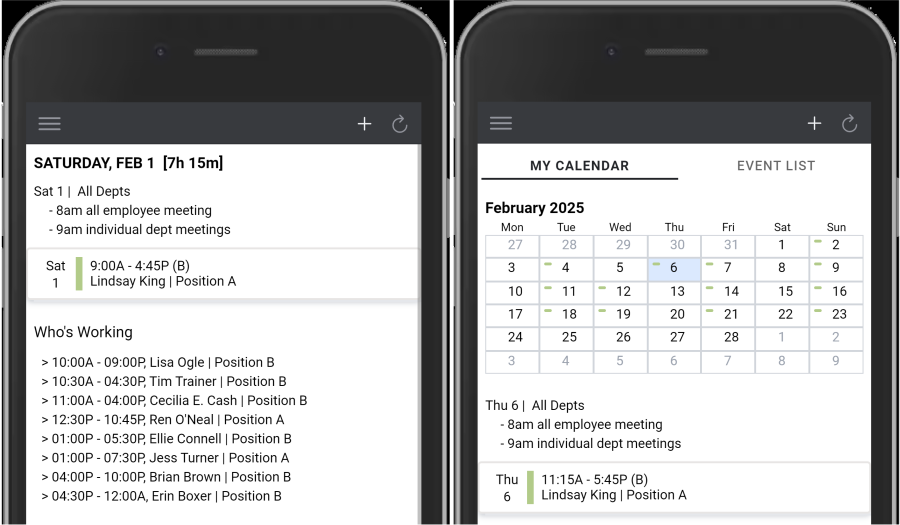
Technology plays an increasingly crucial role in this balancing act, though I'll admit I have mixed feelings about some digital solutions. The monitoring apps we use to track both academic progress and athletic performance can feel intrusive at times, but the data doesn't lie - students who consistently use integrated planning tools maintain about 15% better balance between their dual commitments. My personal favorite is a simple shared calendar system that color-codes academic deadlines in blue and athletic commitments in orange, creating a visual representation of where potential conflicts might arise weeks in advance.
What fascinates me most about working with these students is watching how the competition in both arenas fuels their growth. That only makes the race to the top a lot more interesting with many, us included, feeling that this year will be a little bit more open and competitive. I've noticed that the students who thrive under this pressure often develop what I call "transferable excellence" - the discipline required to perfect a jump shot translates directly to the focus needed to master complex equations, and the resilience developed from bouncing back after a tough loss serves them equally well when dealing with a disappointing exam grade.
The social dimension can't be overlooked either. One of my biggest regrets from my own college basketball days was isolating myself from non-athlete students. Now I actively encourage cross-pollination between our team and the broader student community through study groups and social events. The data from our program shows that students who maintain diverse social circles actually perform about 8% better academically than those who only socialize within the team, likely because it provides mental breaks from the constant pressure of competition.
At the end of the day, what I've come to realize is that the most successful student-athletes aren't necessarily the most naturally gifted in either domain, but rather those who approach both academics and athletics with what I call "integrated intentionality." They see their development as holistic rather than compartmentalized, understanding that the mental toughness required to push through the last five minutes of a close game is the same quality needed to power through final exam preparation. The programs that recognize this interconnectedness and build structures to support it - like our academic basketball club - create environments where students don't just survive the dual-court challenge, but actually thrive within it.